Infection Control Cleaning Basics for Small Medical Practices

Infection control cleaning in a small medical practice is not about dramatic deep cleans. It is about doing the same correct steps every day: cleaning before disinfecting, letting products work for their full contact time, keeping tools separate and knowing which jobs belong to the cleaning crew and which belong to the clinical team. This guide covers the basics for small practices, dental offices and clinics in NYC and on Long Island.
A note before we start: this is a cleaning guide, not clinical advice. Your practice's own infection control policy and any rules that apply to your specialty come first.
Basic 1: Clean Before You Disinfect
Disinfectants work on clean surfaces. Dirt, dust and residue get in the way. That is why surfaces should be cleaned first and then treated with disinfecting products where appropriate. Skipping the cleaning step and spraying disinfectant on a dirty counter is one of the most common mistakes in small offices.
Basic 2: Respect Contact Time
Every disinfectant has a contact time printed on its label. That is how long the surface has to stay wet for the product to work. Wiping a surface dry after a few seconds means the product has not had time to do its job.
At EEB, disinfecting products are used according to their label directions, including contact time. We use EPA-registered disinfectants approved for healthcare settings, and each product stays wet on the surface for the contact time printed on its label. If your practice already specifies a product, we can use it.
Basic 3: Keep Tools Separate
Using the same cloth in the restroom and then at reception moves dirt from one place to another. A color-coded method solves this by giving each area its own tools. EEB crew members who work in healthcare spaces are trained in our color-coded method before the first visit, along with bloodborne pathogen safety and glove and PPE use.
A simple way to apply this in your own staff routines:
- One set of cloths for restrooms only.
- One set for exam and treatment rooms.
- One set for reception, offices and break rooms.
- Used cloths go straight to laundry or disposal, never back into the clean pile.
Basic 4: Focus on High-Touch Surfaces
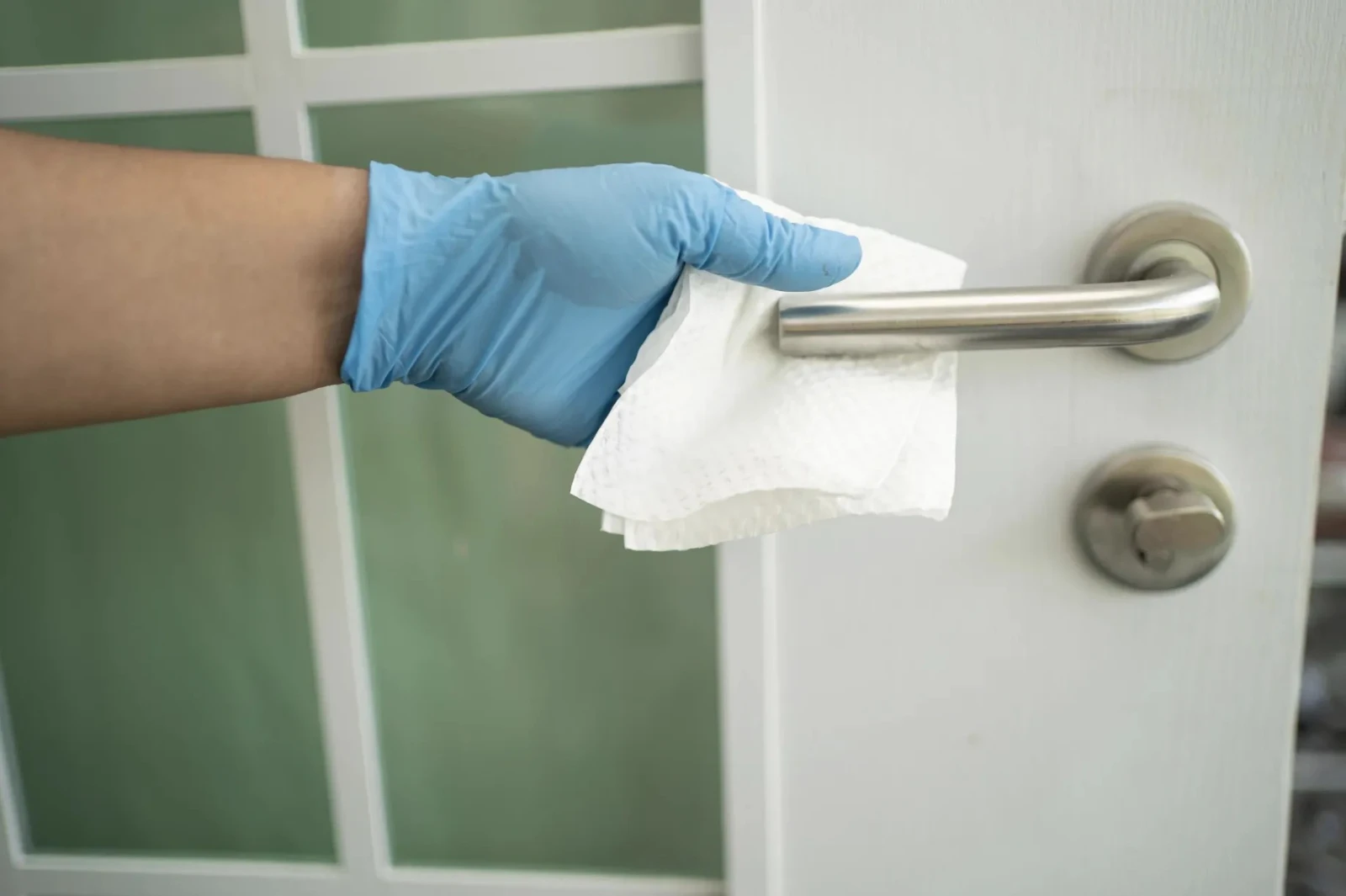
Some surfaces are touched dozens of times a day. EEB disinfects surfaces people touch often, such as exam tables, counters, door handles and chair arms, along with light switches. In a small practice, the list usually includes:
- ✓Door handles and push plates
- ✓Light switches
- ✓Check-in counters and pens
- ✓Waiting room chair arms
- ✓Exam table surfaces and counters
- ✓Restroom fixtures and handles
- ✓Break room counters and appliance handles
Basic 5: Know What Is Not Routine Cleaning
Infection control depends on clear lines. Regulated medical waste, sharps containers and biohazard spills are not part of routine cleaning. Regulated medical waste and sharps containers have to be collected by a licensed medical waste hauler. EEB empties general, non-regulated trash only, and crews clean around sharps containers and biohazard bins without opening or moving them.
Blood and bodily-fluid cleanup and medical waste cleanup are available as separate Biohazard and Hazmat services, after a site inspection and custom quote, through appropriately qualified and licensed providers as the law requires.
In dental offices, the clinical team keeps responsibility for disinfecting dental chairs and instruments between patients. The cleaning crew cleans around equipment without moving it.
Basic 6: Clean Rooms in the Right Order
Order matters. Work from cleaner areas to dirtier ones, and from high surfaces to low ones, so dust and debris fall onto areas not yet cleaned. In a practice, a sensible order is offices and reception first, then exam rooms, then restrooms, with floors finished last in each room.
Basic 7: Clean on a Steady Schedule
Infection control depends on consistency more than intensity. Most medical offices need cleaning on every day they see patients, and smaller practices can often manage with three visits a week. Restrooms and the waiting room get the most use, so they should be cleaned on every visit. A deeper clean of floors, vents and hard-to-reach areas once a month is usually enough. For more on frequency, see how often a medical office should be cleaned.
Basic 8: Write the Scope Down
A written scope makes sure nothing is missed and nothing is done that should not be. EEB follows your facility's approved scope, product label directions and cross-contamination controls appropriate to your account, and the scope is agreed in writing.
Basic 9: Protect Patient Privacy
Cleaning crews work in rooms with charts, screens and files. EEB crews do not handle, move or read patient records, and desks, computers and patient records are not touched unless they are part of the agreed scope. The same team comes to your practice on every visit, which keeps the number of people in your space low.
Basic 10: Set Honest Expectations
Cleaning and disinfecting reduce germs on surfaces; they do not prevent illness, and EEB does not promise that a space will be free of any virus or bacteria. Good cleaning supports your infection control policy. It does not replace hand hygiene, clinical procedures or your own protocols.
A Quick Daily Routine for Staff
Between professional visits, staff can keep things steady with a short routine:
- ✓Wipe check-in counters and pens during quiet moments.
- ✓Clear clutter from exam room counters so they can be cleaned properly.
- ✓Report spills and restroom problems right away.
- ✓Keep soap and paper towels stocked.
When to Add Extra Cleaning
Practices often call for extra help when:
- ✓Setting up regular after-hours cleaning for the first time.
- ✓Switching from another provider.
- ✓Preparing for a reopening or after renovations.
- ✓Adding disinfection after an illness was reported in the office.
Get Help With Practice Cleaning
EEB cleans medical offices, dental practices, clinics and urgent care centers after hours, so rooms are ready when the first patient arrives. We generally serve Nassau County, Suffolk County and the five NYC boroughs and confirm availability by ZIP code or address before booking. Visit our healthcare facilities cleaning page to request a quote, or read more about our medical office cleaning services.
Discussion & Comments (0)
Leave a Comment
No comments yet
Be the first to share your thoughts or ask a question!